Could a solar storm shut down the grid?
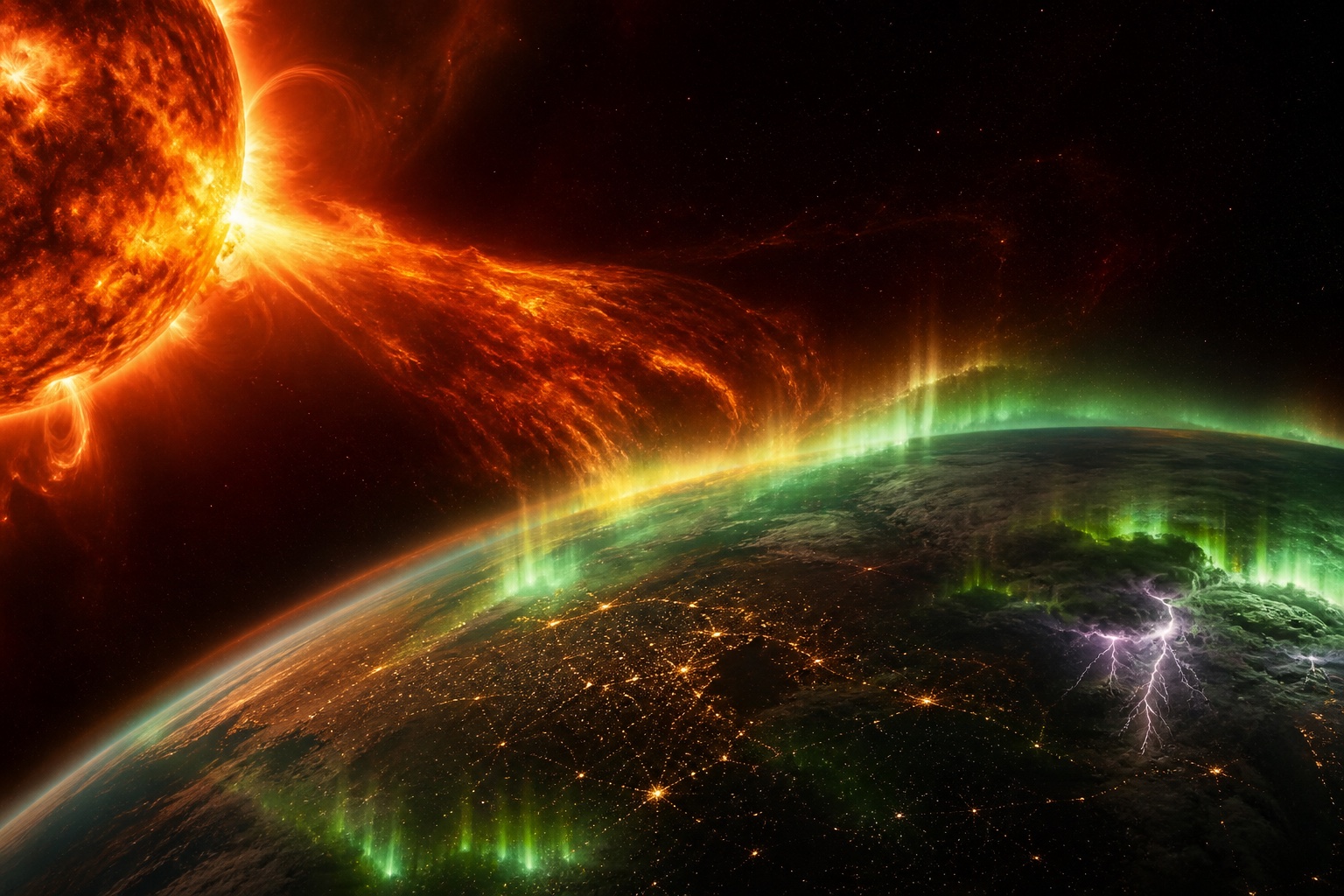
An extreme storm can push currents through long power lines, disrupt satellites, scramble navigation, and interfere with radio. That is a serious infrastructure emergency—not the Sun physically burning people on the ground.
Light arrives fast. Plasma takes the long road.
“Solar storm” is not one single thing. A flare sends electromagnetic energy; a coronal mass ejection sends a vast cloud of plasma and magnetic field. They travel differently and threaten different systems.
Solar flare
Light and X-rays reach Earth in about eight minutes. Strong flares can disturb the ionosphere and trigger radio blackouts on Earth’s sunlit side.
Coronal mass ejection
A fast Earth-directed CME can arrive in under a day; slower ones take several days. Its magnetic orientation helps determine how strongly it couples with Earth’s field.
THE BENCHMARK: The 1859 Carrington Event remains the strongest recorded geomagnetic storm. It is a planning reference—not proof that another one is scheduled.
G1 is not G5.
The numbered scale works like a severity ladder. It describes possible effects, not a guarantee that every listed consequence will occur everywhere.
Weak grid fluctuations and minor satellite effects are possible. Aurora becomes the headline.
High-latitude utilities may see voltage alarms. HF radio can fade and satellites may need corrections.
Grid operators may make voltage corrections. Intermittent navigation and HF radio problems become possible.
Wider voltage problems and incorrect protective trips can occur. Satellite, radio, and navigation disruptions may intensify.
Some grid systems could experience collapse or blackouts, transformers may be damaged, and navigation or HF radio may be degraded for extended periods.
 FROM THE SUN TO THE SWITCHBOARD
NOAA watches. Grid operators prepare.
Space-weather forecasting gives governments and infrastructure operators time to protect satellites, adjust aviation or communications, and take defensive steps on the grid. Households should use the same window to complete ordinary outage preparations—not chase viral predictions.
- 01Solar eruption detected
Spacecraft observe flares, particles, and CMEs leaving the Sun.
- 02Trajectory modeled
Forecasters estimate whether a CME is Earth-directed and when it may arrive.
- 03Watches and warnings issued
NOAA communicates expected severity as observations improve.
- 04Final intensity unfolds
Near-Earth measurements reveal the magnetic conditions that help drive the storm.
Prepare for the outage—not the headline.
You cannot personally shield the national grid. You can keep essential information, light, water, medicine, and limited power available while utilities restore service.
Use NOAA for space weather and local officials for outage instructions. Keep a battery radio and printed contacts.
Top off power stations and battery banks. Decide which phones, medical devices, lights, and radios must stay powered.
Keep refrigerator and freezer doors closed, store drinking water, and follow any local water advisories.
Generators belong outdoors, at least 20 feet from openings. Never improvise indoor combustion power.
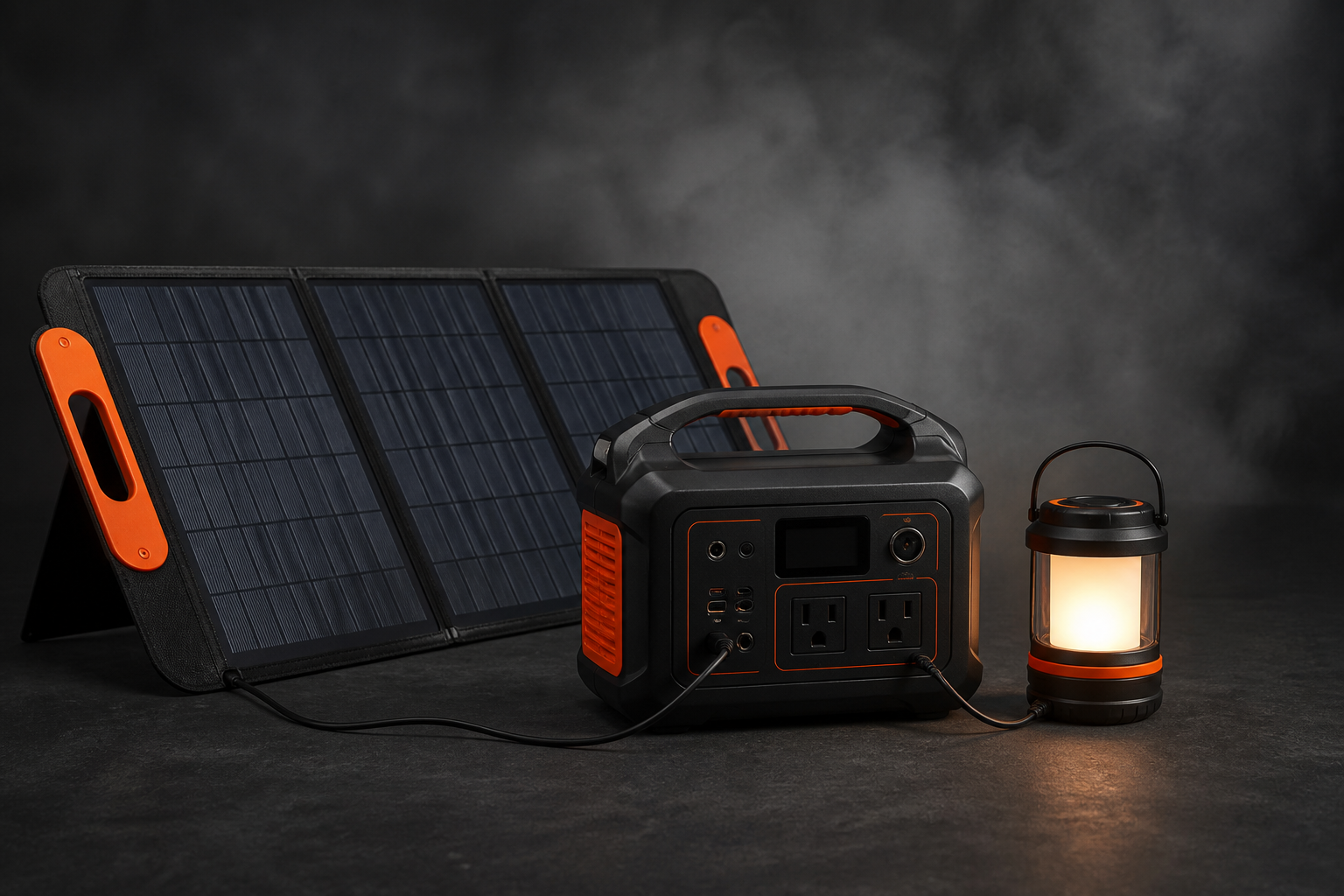
A portable power station is energy storage—not a promise of whole-home power. Match capacity to the devices you truly need and follow every manufacturer’s safety instructions.
Signal over static.
Can a solar storm end the world?
Not in the literal extinction-event sense. An extreme storm can disrupt technology across large areas—especially power transmission, satellites, GPS, and some radio—but Earth’s atmosphere and magnetic field continue protecting people on the ground from most direct radiation.
Would every phone and laptop instantly be destroyed?
That is not the main threat described by NOAA. The greatest concerns involve long conductors and large systems such as power lines, pipelines, satellites, and radio or navigation infrastructure. A household should plan for lost power and communications rather than assume every small device will be fried.
How much warning would we get?
A solar flare’s energy reaches Earth in about eight minutes, so radio effects can be nearly immediate. An Earth-directed coronal mass ejection usually takes many hours to several days to arrive, allowing NOAA to issue watches and forecasts, though final storm strength can remain uncertain until the cloud is measured closer to Earth.
Do I need a Faraday cage?
For most households, it should not come before water, food, medicine, light, radio, backup power, surge protection, and an offline communication plan. No container can keep the electrical grid or cell network operating; practical outage readiness provides broader value.
What should I do during a severe solar-storm alert?
Follow NOAA Space Weather Prediction Center updates and instructions from local utilities or emergency officials. Charge batteries, protect essential electronics from ordinary surges, preserve food by keeping refrigerators closed, use generators only outdoors, and treat any outage like a potentially extended one.
Sources and live alerts
Space weather changes by the hour. Check current NOAA products rather than treating an old article as a live warning.