
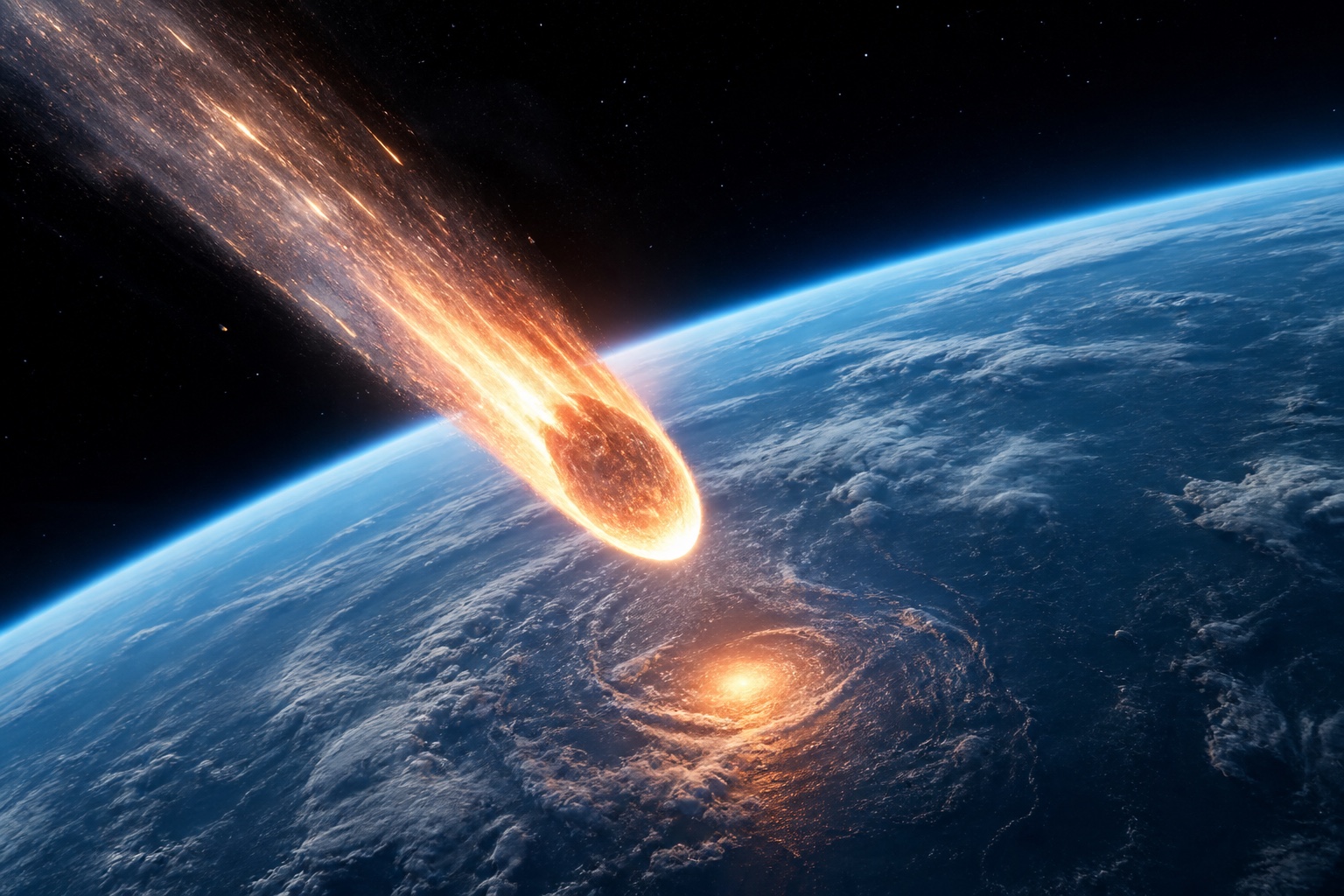
Could an asteroid end the world?
But NASA says no known asteroid currently poses a significant impact threat for the next 100 years or more.
Fireball, city-killer, or extinction event?
“Asteroid” covers everything from a rock that flashes harmlessly overhead to a body capable of changing the planet. These NASA estimates show why headlines without a size are almost meaningless.
A brilliant fireball and powerful sonic boom. Nearby windows can break, but objects this small usually do not reach the ground intact.
Local devastation becomes possible. The object may explode in the atmosphere or form an impact crater.
Damage could extend across a metropolitan area or wider region, depending on where and how it strikes.
Global devastation and climate effects become possible, with consequences far beyond the impact zone.
The extinction-level class associated with planet-wide environmental effects. This is movie-scale—and exceptionally rare.
Find it early. Track it. Change the ending.
NASA’s Planetary Defense Coordination Office works with observatories and international partners to discover near-Earth objects, calculate their paths, and communicate credible hazards.
- 01Discover and track
Telescopes repeatedly observe an object so scientists can refine its orbit instead of reacting to an early, uncertain estimate.
- 02Measure the actual risk
NASA’s CNEOS and Sentry systems analyze possible future paths and update probabilities as better observations arrive.
- 03Deflect—if there is time
NASA’s DART mission proved that a spacecraft impact can alter an asteroid’s orbit. Years or decades of warning would create far more options than a last-minute discovery.
Don’t buy an “asteroid kit.” Prepare for the aftermath.
There is no universal product that protects a home from a direct impact. The smart plan is to follow official alerts, evacuate when directed, and prepare for the disruptions that can follow a distant regional event.
If officials identify a credible threat, the projected location and warning time will determine the right action. A household should never ignore an evacuation order to shelter beside its supplies.
Questions worth asking.
Is an asteroid currently heading toward Earth?
NASA says there is currently no known significant asteroid-impact threat for the next 100 years or more. Scientists continue discovering and tracking near-Earth objects, so NASA and JPL are the right places to check—not viral posts.
Could an asteroid actually end civilization?
A sufficiently large impact could cause global devastation and climate disruption. Size, speed, composition, impact angle, and location all matter. The civilization-scale objects are also dramatically rarer than the small objects that burn up in the atmosphere.
Can NASA stop an asteroid?
Possibly, if a dangerous object is found early enough. NASA’s DART mission successfully changed the orbit of the asteroid moonlet Dimorphos, demonstrating one possible deflection technique. A real response would depend on the object and the warning time.
What should a household do if an impact is predicted?
Follow official instructions for the projected impact area. Evacuation may matter more than supplies near the hazard zone. Farther away, a power-outage and supply-disruption plan—water, food, medicine, light, radio, backup power, and family communication—covers the most practical consequences.
Official sources
Risk estimates change as new observations arrive. These are the sources to trust for current information.